The AI context layer that makes agents trustworthy
Cube gives your AI agents a governed context layer — the context they need to answer correctly. Point an LLM at raw tables and it re-derives joins and metric logic on every prompt, so the same question returns different numbers. The context layer gives the agent certified metrics, dimensions, joins, and access rules to select from, so answers are consistent, governed, and explainable.




 and 50+
What's in an AI context layer
- The semantic layer at the coreMetrics, dimensions, joins, and access rules defined once and enforced — the governed shape and math the agent selects from instead of re-deriving it from raw tables.
- Business concepts, rules, and modeling guidanceThe glossary, business logic, and conventions the model alone doesn't capture — what a term means, the edge cases and exclusions that decide a correct answer, and how the data should be modeled and extended.
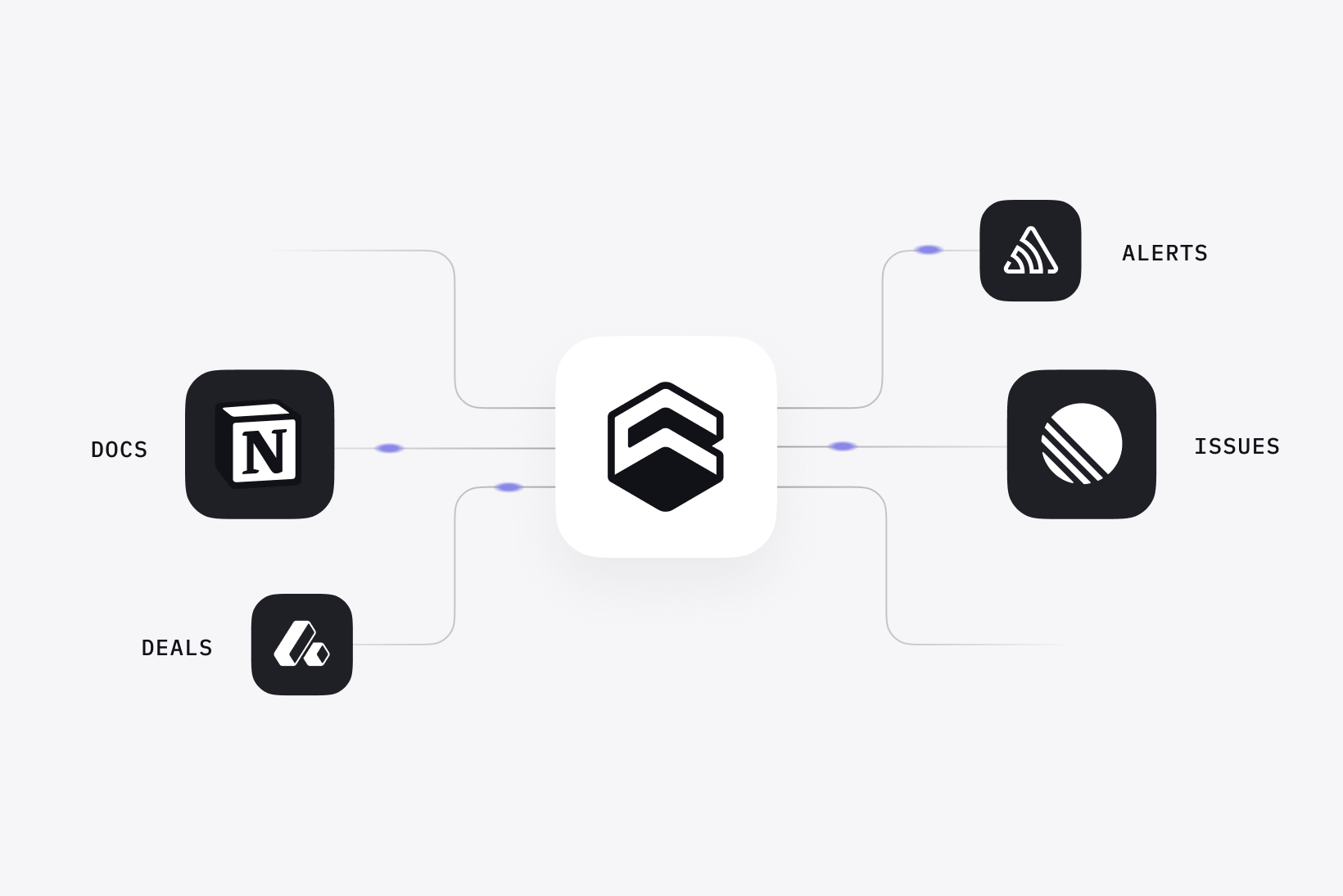
- Lineage and external contextEvery answer traces back to named definitions and their sources, and the agent can pull context from the tools around the warehouse — docs, tickets, incidents — over MCP Connectors.
Test your agent like a production system
An agent answering business questions in production is a production system — and production systems have tests. Write eval cases (a question and its known-correct answer), run your agent against them on any branch, and get an objective accuracy score with a per-case breakdown of what failed and why. Change a model or an agent config, re-run, and catch the regression before it ships.
Reach any agent over MCP
- One governed model, every agentClaude, ChatGPT, Cursor, or one you build — each queries the same governed model as a tool over MCP.
- No per-agent reworkDefine metrics and joins once; every connected agent inherits the same context without a separate integration.
- Bring your own agentIf it speaks MCP, it can query Cube — your custom agents get the governed model for free.
Pull context from the tools your team already uses
Governed metrics answer what the numbers are; the why usually lives in a doc, a ticket, or an error tracker. MCP Connectors let the Cube agent pull that external context and use it in the same turn as a semantic-layer query — so answers stay grounded even when the context comes from outside the warehouse.
Brex grounds its embedded agentic analytics on Cube's governed model, so answers stay consistent and scoped to each customer. Brex chose Cube over the dbt Semantic Layer and LookML.Read the story
Frequently Asked Questions
Teams grounding their agents on Cube
“Cube becomes our single source of truth for metric definitions and powers everything from customer-facing dashboards to AI-driven quarterly business reviews. CSMs gain back dozens of hours each quarter, enabled by Cube’s semantic layer and agentic analytics.”

“We integrated Cube Cloud smoothly with ClickHouse, leveraging both for fast query execution while maintaining the abstraction needed for different teams to access data without diving into database-specific complexities.”
“Without Cube, our data analysts might have to write 20 different queries for a single core business metric. With Cube, that metric is defined once in the data model, and every downstream tool uses that definition along with the associated calculation logic.”