A context layer is the governed business context an AI agent uses instead of guessing from raw tables. In analytics, it gives the agent certified metrics, dimensions, joins, permissions, lineage, and supporting knowledge so the same question returns the same answer for the right user. The semantic layer is the core of that context layer; the broader context layer wraps it with the business rules and surrounding information an agent needs to reason safely.
A working definition
For analytics, a context layer is the runtime layer that tells an AI agent what the business means. It sits above the warehouse and downstream of transformation, then exposes governed concepts to the agent: measures such as revenue, dimensions such as region, join paths between entities, access rules for the current user, and descriptions that explain when each concept should be used.
That matters because raw tables are not enough context. A schema can show a column named
amount, but it does not say whether revenue is gross or net, whether refunds are excluded, which
customer table is authoritative, or whether the person asking may see a tenant's rows. Pointed at
raw tables, an LLM has to infer those rules every time. Pointed at a context layer, it selects from
definitions the data team has already modeled and governed.
This is why context is a layer, not a larger prompt. A prompt can tell the model about your data, but it cannot reliably enforce row-level permissions or compile a correct metric query. A context layer provides a controlled surface the agent can inspect and call.
Context layer vs. semantic layer
The context layer and the semantic layer are closely related, but they are not the same thing.
The semantic layer is the governed analytical model. It defines metrics, dimensions, joins, and access policies once, then serves those definitions to BI tools, embedded applications, APIs, and agents. It is the part that keeps "revenue" from meaning one thing in a dashboard and another thing in an AI answer.
The context layer is broader. It includes the semantic layer, then adds the information an agent needs to choose, explain, and verify its work: business vocabulary, metric descriptions, modeling guidance, lineage, evaluation cases, and external context from systems such as docs, tickets, and incidents. If the semantic layer is the governed shape and math of the business, the context layer is the full operating context the agent uses around that model.
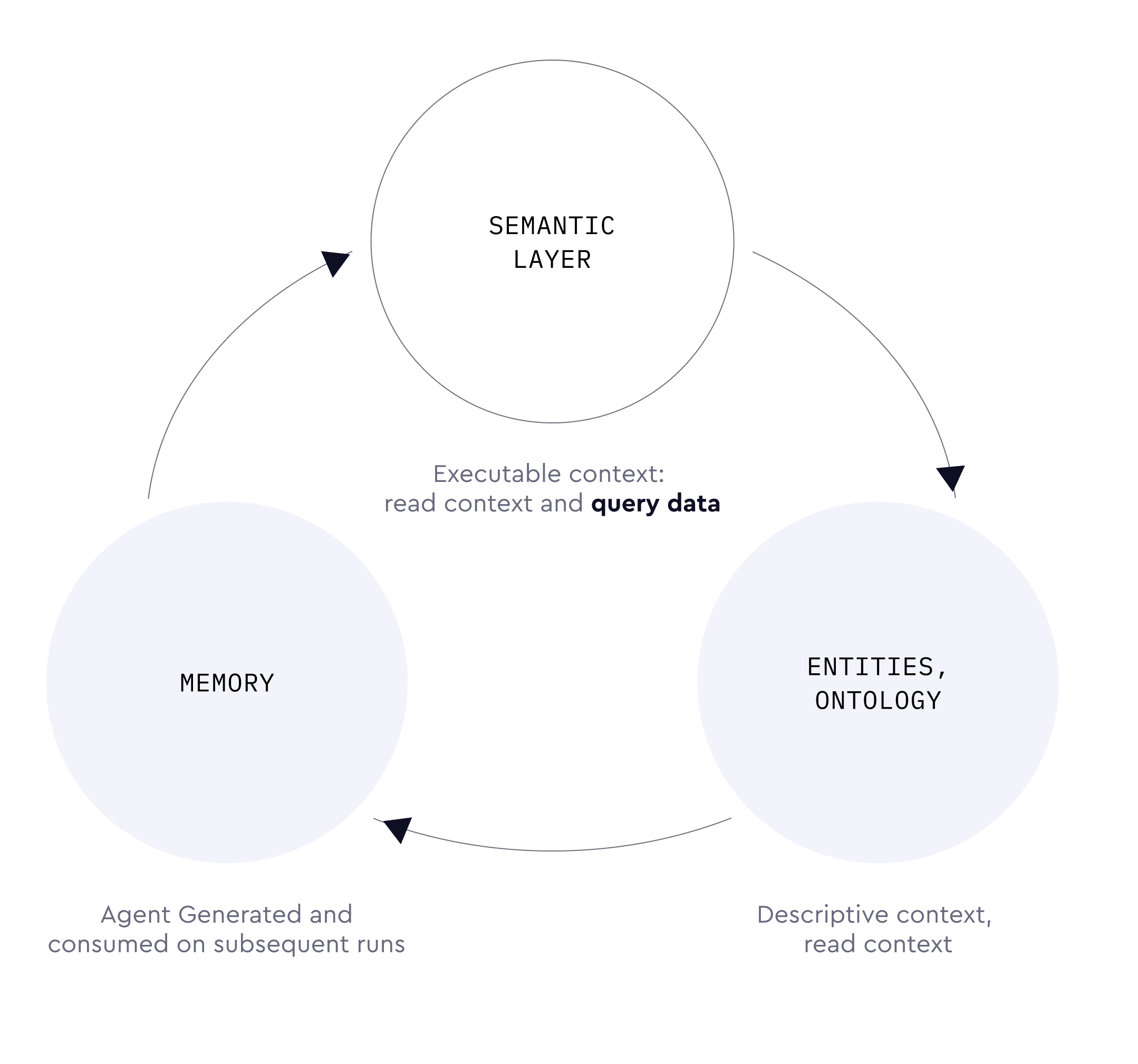
Cube's engineering team makes this case in depth in The Context Layer Needs a Semantic Layer: the "context layer vs. semantic layer" framing is a false choice. The context layer is the superset — everything an agent needs to answer a business question correctly — and the semantic layer sits inside it as the one part that actually executes.
That distinction is useful because agents need more than metric definitions. They need to know which metric is certified, when one definition supersedes another, why a number changed, and where to look for non-warehouse context that explains the movement. But without the semantic layer at the core, the rest of the context has no governed analytical foundation.
Why agents need more than table schemas
Text-to-SQL gives a model access to data, not understanding of the business. The model can produce a syntactically valid query and still choose the wrong grain, join through the wrong table, apply the wrong revenue definition, or omit the user's access rules. The failure is subtle because the answer often looks polished.
A context layer changes the task. The agent discovers certified metrics and dimensions, requests them by name, and lets the layer compile the query with the user's permissions applied. It can still slice, filter, group, compare periods, and build ad-hoc calculations, but those moves happen on top of governed definitions rather than around them.
For production AI agents for data analysis, this is the trust boundary. The agent should not be the authority on what revenue means. It should be the planner and explainer that works over a trusted model.
What belongs in an analytics context layer
A useful analytics context layer usually has six parts.
Semantic model. Metrics, dimensions, entities, joins, grains, and access policies live in a reviewable model. This is where the hard analytical decisions are made once instead of being repeated in every prompt.
Query interfaces. Agents and tools need controlled ways to reach the model. SQL, REST, and GraphQL serve BI tools and applications; MCP gives agents a structured way to discover and query governed concepts.
Governance. Access rules should be applied before the query runs. When the user's tenant, role, or region is part of query compilation, an agent cannot simply forget a tenant filter or ask for rows the user is not allowed to see.
Business vocabulary and modeling guidance. Agents need descriptions, synonyms, exclusions, and edge cases. If "bookings" and "revenue" are both available, the context layer should help the agent choose the right one for the question.
Lineage and explainability. Answers should trace back to named definitions and sources. This is how a user, analyst, or reviewer can tell why the answer was produced and whether the agent chose the right context.
Evaluations and external context. Known questions with known answers make the agent testable, and surrounding systems often explain the "why" behind a metric movement. For example, data governance for generative AI usually depends on both governed data access and operational context outside the warehouse.
How MCP makes context usable by agents
The Model Context Protocol matters because it turns context into something an agent can discover and call. Instead of stuffing table documentation into a prompt, an MCP server exposes tools and resources the agent can inspect at runtime: available measures, dimensions, filters, descriptions, and sometimes surrounding systems such as docs or incidents.
For analytics, the flow is straightforward. The agent asks what metrics and dimensions exist, chooses certified definitions, requests a governed result, and receives data with permissions already applied. SQL, REST, and GraphQL still matter for dashboards, notebooks, and application developers, but MCP is the agent-facing interface that lets context stay structured.
This is the architectural reason semantic layers for AI agents are becoming more important. The agent needs a small, governed surface to reason over. The context layer provides that surface and the protocol to use it.
Where Cube fits
Cube is the agentic analytics platform, built on a semantic layer. Its open-source foundation, Cube Core (Apache 2.0), defines metrics, dimensions, joins, and access rules once, sits on top of the warehouse, and serves governed analytics over SQL, REST, GraphQL, and MCP. The Cube platform adds AI agent interfaces, workbooks, dashboards, embedded surfaces, multi-tenancy, managed performance, evals, and external tool context around that core.
That is Cube's AI context layer: governed analytical context for agents across internal BI and embedded analytics. The agent selects from certified definitions instead of writing raw SQL against tables, and the same model continues to serve dashboards, embedded product surfaces, and APIs. Cube does not replace Snowflake, BigQuery, Redshift, or Databricks; it sits on top of the warehouse. It also does not replace dbt; Cube can read dbt models while dbt continues to own durable transformations.
The point is not to give the model more raw access. It is to give it less guessing to do.
Methodology
This explainer defines the AI context layer as the term is used in analytics and agentic BI, weighted toward what an agent needs in production: certified metric definitions, governed access, lineage, evaluation, and structured interfaces such as MCP. Product capabilities move quickly, so confirm current details against documentation before treating any vendor claim as fixed. As the publisher, Cube has an obvious interest here; the article separates Cube Core as the open-source semantic layer from Cube as the broader agentic analytics platform built on that foundation.
Frequently asked questions
- What is a context layer?
- A context layer is the governed business context between raw data and an AI agent. It gives the agent certified metric definitions, dimensions, relationships, permissions, lineage, and surrounding knowledge so it can answer with the same meaning a data team would use. In analytics, the semantic layer is the core of that context layer.
- What is an AI context layer?
- An AI context layer is the context an AI agent queries instead of guessing from raw tables. It includes governed metrics and joins, access rules, business definitions, lineage, and external context from systems such as docs or tickets. The goal is to make the agent's answers consistent, governed, and explainable.
- How is a context layer different from a semantic layer?
- They are not alternatives. A semantic layer defines the analytical model: metrics, dimensions, joins, and access policies. A context layer uses that semantic layer as its core and adds the extra context an agent needs, such as business vocabulary, modeling guidance, lineage, evaluations, and information from other tools.
- Why do AI agents need a context layer?
- Agents need a context layer because raw schemas do not explain business meaning. A table can show orders and customers, but it does not tell the model which revenue definition is certified, which join path is safe, or which rows the user may see. A context layer gives the agent a governed surface to select from instead of forcing it to infer those rules every time.
- Is a context layer just prompt engineering?
- No. Prompt engineering can describe the data, but it does not enforce metric definitions, permissions, or lineage. A context layer is a runtime and modeling layer: the agent discovers governed definitions, requests them through controlled interfaces, and receives answers with access rules applied before the query runs.
- How does MCP fit into a context layer?
- MCP gives agents a standard way to discover and call tools. In an analytics context layer, an MCP server can expose certified measures, dimensions, filters, and supporting tools so the agent selects from governed context rather than writing arbitrary SQL against raw tables. SQL, REST, and GraphQL can serve the same model for non-agent consumers.
- Does a context layer replace dbt or the data warehouse?
- No. The warehouse remains storage and compute, and dbt remains the transformation layer for many teams. The context layer sits on top of the warehouse and alongside dbt, governing query-time metrics and serving them to BI, embedded analytics, and AI agents.
- What should be in an analytics context layer?
- At minimum it should include a semantic model, access policies, query interfaces, business definitions, lineage, and evaluation cases for known questions and answers. For agents, it should also expose context over MCP and connect to surrounding systems where useful explanations live, such as docs, tickets, and incidents.
- What does Cube provide as a context layer?
- Cube is the agentic analytics platform built on a semantic layer. Cube Core defines governed metrics, dimensions, joins, and access rules, while the Cube platform adds AI agent interfaces, workbooks, dashboards, embedded surfaces, multi-tenancy, managed performance, evals, and MCP-based context for agents.